Filed Under:
Alaska Natives navigate blocks from state government, fishing industry to maintain their lifeways
The U.S. Supreme Court ruled against the state of Alaska to affirm subsistence fishing rights
Alyssa Choiniere
Real journalists wrote and edited this (not AI). Independent, community-driven journalism survives because you back it. Donate to sustain Prism’s mission and the humans behind it.
Real journalists wrote and edited this (not AI)—independent, community-driven journalism survives because you back it. Donate to sustain Prism’s mission and the humans behind it.
For seven years, Robert Nicholas has carefully protected the last strips of salmon remaining from the 2019 harvest, keeping them buried in the deepest part of his freezer where the air cannot spoil them with freezer burn. He wants to save them for his grandchildren.
“Those kids are amazing,” Nicholas told Prism. The salmon is their birthright, he said. “I talk for them. I talk for my people. To us, that’s our lifestyle, and right now, our freezers are empty.”
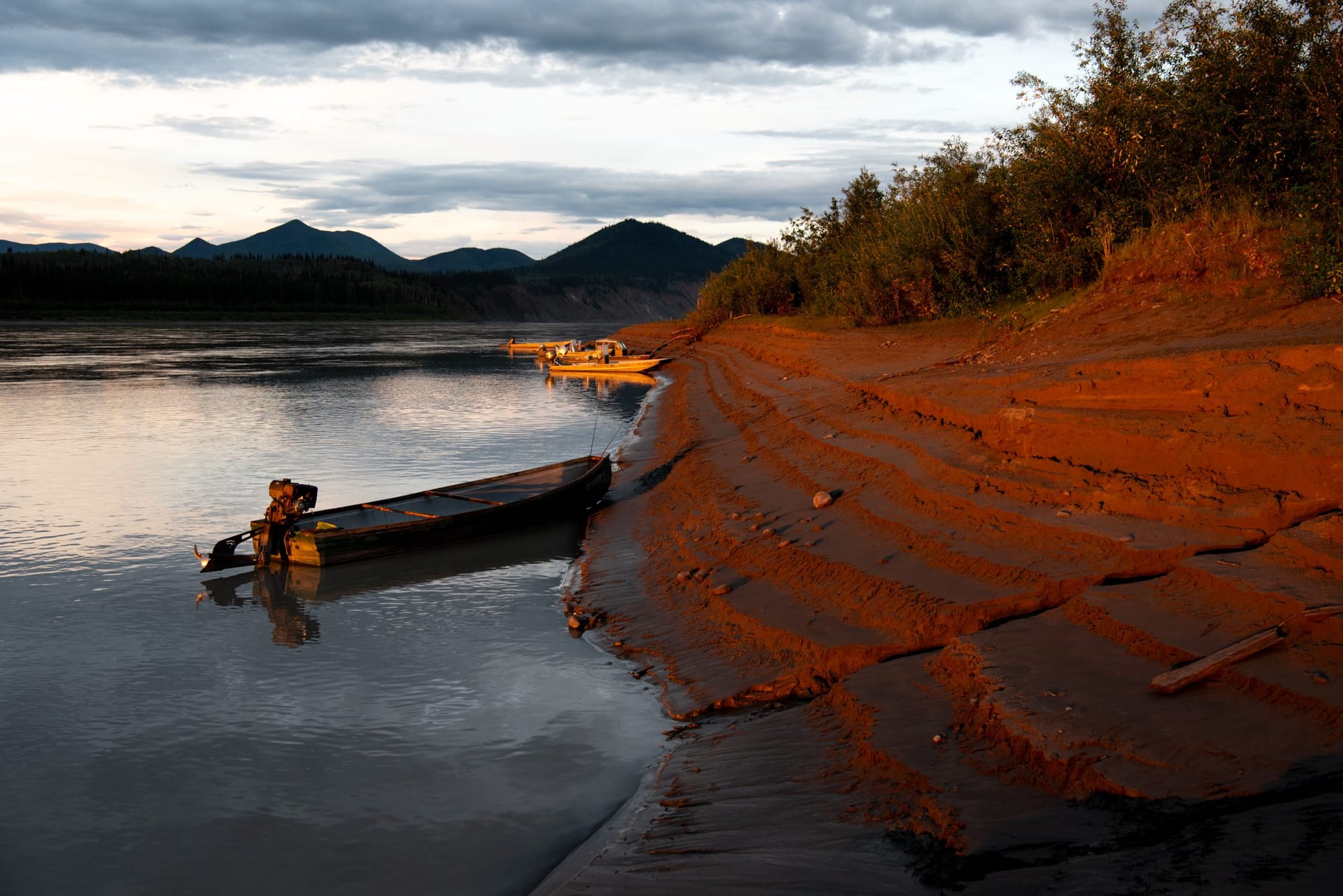
Nicholas was born and raised in the rural village of Kaltag on the Yukon River, home to about 150 people, more than 300 miles from both Anchorage and Fairbanks. Kaltag’s traditional name, Ggaal Doh, means “Place of the King Salmon,” but salmon stocks have collapsed. King salmon fishing on the Yukon River was made illegal by a moratorium in 2024, while commercial fishing in the ocean continues to deplete the number of salmon that find their way back to the rivers to spawn. Like the majority of Alaska’s 240 remote villages, Kaltag is disconnected from the highway system, and locals rely on the river and the land for their food.
Nicholas’ three grandchildren live in Fairbanks. Like many Alaska Natives, some of his family members left home to find work, with Indigenous lifeways becoming an increasingly difficult way to survive. State policies in Alaska that challenge subsistence rights favor commercial industries over the Indigenous peoples who have lived on and protected the land since time immemorial. Climate change only compounds those bureaucratic barriers.
While the state was in court arguing against Alaska Natives’ right to harvest, Nicholas said he saw the ecosystem collapsing and members of his community struggling to feed themselves.
“They wipe out our way of life,” he said. “It’s all about politics. It’s all about money.”
At 69 years old, Nicholas said he works as a plant operator, a contractor for the local airport, and as a furnace repairman. His years of work have helped him weather the financial storm caused by the ecosystem collapse, but he plans to keep working as long as he can to help provide for his grandchildren.
Despite treaty rights that promised continuity of the Indigenous right to access their foodways, colonial governments have pitted Alaska Natives against state decision-makers and the billion-dollar pollock industry, which further depletes salmon stocks through incidental catches known as bycatch.
Nicholas has a treaty right to subsistence fishing, hunting, and gathering. Despite this, he’s spent half of his life unable to exercise that right fully due to a state challenge. That challenge came to a close in January, when the Supreme Court affirmed in U.S. v. Alaska that Alaska Natives maintain subsistence treaty rights.
While the Supreme Court decision not to review the state’s challenge to treaty rights affirms the foundational right for subsistence, the harvests continue to be decimated in the ocean by trawl fishers, an industrial fishing technique that scoops up fish by dragging large nets behind boats, catching the targeted species, but often killing additional species in the process. Chum salmon—which Alaska Natives have harvested for generations to feed themselves—is among the species that has been depleted, in part, by bycatch.
The North Pacific Fishery Management Council (NPFMC), which manages Alaska’s coastal waterways, hosted a meeting from Feb. 5-11 to hear public testimony on bycatch, and agreed at the conclusion of the meeting to set a limit of 45,000 on bycatch for chum salmon. But this bycatch limit isn’t any lower than the average annual rate, meaning that commercial fishers can continue to conduct business as usual in a move nonprofit organization, Salmon State, referred to as “Making Nothing Look Like Something.”
Alaska Natives have pleaded with the NPFMC board to set meaningful limits on bycatch, often at great financial cost. A plane ticket alone to travel from Kaltag to Anchorage costs around $850.
Kimberly Nicholas—who is related to Robert Nicholas through her husband—was one of 170 people who testified at the February NPFMC meeting on chum salmon bycatch. Without salmon, she said, “we’ve just been at a loss.”
Kimberly Nicholas said it can be difficult mentally and emotionally to articulate to a board in a three-minute time slot what Alaska Natives experience on a day-to-day basis.
“It does take a toll,” she said. “Then you’re talking to this board, and they’re just listening, so you’re not really sure if what you said made a whole lot of difference. But it’s better than not showing up. We’re trying to build a record.”
The long fight to uphold subsistence rights
The subsistence priority that the state of Alaska has continually challenged was established so that rural Alaskans, disconnected from the highway system, could access the land and waters they depend on for food. The U.S. Supreme Court decision in January quashed the latest challenge by the state of Alaska, which had asked the court to reconsider federal subsistence priorities for rural Alaskans, the majority of whom are Indigenous.
The state of Alaska has argued that granting priority to some Alaskans violates its state constitution, but Alaskans’ access to food is unequal. Food insecurity has increased by 50% in Alaska Native villages since the salmon collapse in 2019. Statewide, 49% of households with children and 35% of households with elders were eligible for Supplemental Nutrition Assistance Program (SNAP) benefits, with even higher rates in rural Alaska. Indigenous Alaskans who live in their traditional villages have little access to grocery stores, and a trip to Fairbanks from Kaltag is accessible only by airplane and requires a $500 ticket. In Kaltag, Robert Nicholas said a gallon of milk costs $30 and a box of crackers costs $15.
The state’s challenge to the subsistence priority was the latest legal battle in a continually resurfacing conflict between the state of Alaska and Alaska Natives asking the state to uphold their right guaranteed by treaty. Title VIII of the Alaska National Interest Lands Conservation Act (ANILCA) established subsistence priorities in 1980. But in 1984, when Alaska Native Katie John asked the state to open the fishery near her home for subsistence harvest, the state denied the request while opening fishing to sportsfishers and commercial fishers on other parts of the river. That conflict started a 27-year legal battle, known as the Katie John cases. The cases concluded in 2014, when the U.S. Supreme Court affirmed the federal subsistence priority.
Seven years later, the state brought a new case to challenge the subsistence priority. In 2021, declining salmon populations prompted federal managers to close the Kuskokwim River fishery to everyone but local subsistence fishers. State managers opened the fishery to all Alaska residents, conflicting with the subsistence priority. The U.S. sued Alaska for interfering with the subsistence priority, setting off a five-year legal battle between the state and federal government, U.S. v. Alaska, which ended in a victory for subsistence.
Representatives of the state of Alaska did not respond to interview requests.
“The state of Alaska just decided people who live in Anchorage—who can drive to Costco—should have an equal right to go out there and yank fish out of the river as the people who live [on the river],” said Scott Kendall, who was hired by the Alaska Federation of Natives to represent them in the case.
The state’s legal petition claimed that “federal mismanagement” of state fisheries prompted the state’s request to control fisheries.
“Alaska’s fisheries are among the most bountiful in the world,” the petition reads. “They sustain the livelihoods of tens of thousands of Alaskans, creating jobs through commercial fishing and food sources through subsistence fishing.”
But granting all Alaskans equal access to fisheries would mean that Alaska Natives who live along the river and rely on the harvest for survival would have the same level of access as 740,000 Alaskans across the state. The state issues tags by lottery for some game like musk oxen and moose, while the federal subsistence prioritizes access to rural Alaskans, who need it for survival and nourishment.
“Imagine people who live right on the Kuskokwim … entering a lottery with 500,000 other Alaskans. They’re unlikely to win, and they’re sitting there watching those fish being pulled out of the river from their front porch, but they can’t eat them,” Kendall said.
He said he disagrees with the federal mismanagement claim, but that it is irrelevant to whether the state holds control over the harvest.
“I don’t know if they need to go to ‘Schoolhouse Rock’ or something,” he said, referring to the cartoon that has taught U.S. elementary school students about the government since 1973, “but federalism says the federal government is supreme over [the] state. When there’s a conflict, the feds win.”
Kendall called the state’s challenge to subsistence “mean-spirited” and said it represents favoritism to sportsmen’s groups over local residents. While he said some sportsmen’s groups have helped to pave the way for conservation, others have an “antagonism towards the Native cultural way of life, and they have the ear of this particular governor.”
Politics and money have also been blamed by advocates for the NPFMC delay in setting any limit on chum bycatch. The pollock industry, which incidentally catches hundreds of thousands of salmon each year, has been credited as a key driver of Alaska’s economy, but only the negative impacts reach many of Alaska’s inland villages. The Western Alaska Community Development Quota (CDQ) Program redistributes a percentage of fisheries’ revenue to six nonprofit corporations representing 65 coastal communities, about one-quarter of the state’s villages and all located on the coast, while inland villages are left out.
Kimberly Nicholas contends that proper fisheries management must include Alaska Natives.
“I would like them to give us a seat at the table,” she told Prism. “Co-management is what would actually help. We don’t need any more handouts or programs.”
In 2019, at the start of the salmon crash, 18.5 million salmon were caught by commercial vessels, while the total subsistence harvest of salmon in 2019 was about 800,000 salmon.
Robert Nicholas fished on the Bering Sea off the coast of Nome in the 1980s and saw the devastation trawling caused to the ecosystem. He said the problem was largely unknown to Alaska Native villagers at the time. At a meeting in 1995 to discuss the CDQ agreement, he warned the attendees.
“I said, ‘Do not let the trawlers come in here. Otherwise, we’re going to have no fish on the Yukon River, and you’re going to see, it’s going to happen fast,’” he said.
Robert Nicholas said he saw fish stocks plummet from 1990 to 1996, which the state of Alaska celebrated as a “boom” in fishery production, with an increase in catches from 155 million to 218 million, a 40% harvest increase, while he watched fewer fish swimming by his home on the Yukon River.
Thirty years later, he said, “Our whole Yukon River is suffering. … They wiped out three species just by the drop of a hat, and we’ve got no say in it.”
Harvesting moose, which historically made up for calorie deficits when fish harvests were low, has become more challenging with non-local hunters harvesting the big game for trophy antlers.
“We have to fight for everything. We’ve got to fight for our moose too,” he told Prism. “It’s devastating out here to have to deal with outside people wanting to take everything away from us.”
Kimberly Nicholas, who moved to Fairbanks for college in 2000, is the youngest of seven children. When fish were plentiful, she said all of her family members would “migrate home” to fish.
“It’s where we all come back together, and we would tell stories and be with each other,” she said.
Without fish, she shared that it is more difficult to create opportunities for the family to get together and to teach her children about their culture.
Looking for a new channel
Just as Robert Nicholas has stored away the last remaining salmon strips from 2019 to save for his grandchildren, Kimberly Nicholas showed the NPFMC board in 2025 how her family preserved a salmon tail, a totem placed in homes for protection and given to children to place in their pockets during hard times like funerals, alongside rosary beads. She said each family carefully chooses a salmon tail to keep in a separate part of their smokehouse to dry and preserve for this purpose. When her nephew testified, he kept a salmon tail in his pocket to give him strength during his testimony.
Kimberly Nicholas held up the salmon tail for the board to see.
“This fish tail here is from years ago. And it’s protected in this tape,” she said, her voice cracking. “That’s what we have to do, because we haven’t been able to replenish things like this. And what are we going to do in 10 more, 20, 50 more years when we can’t? That’s part of our lives. This is how we were raised and raised our children. This is our family.”
At the February meeting, she told the board that a channel near Kaltag had changed course about five years ago. Debris and overgrowth made it too difficult for the fish to navigate the waterway to swim upriver and spawn. But the day before the meeting, her nephew told her that he saw fish in a creek below Kaltag. They found a new path to follow. “I think that’s what we’re looking for,” she said. “We’re just looking for some hope.”
Editorial Team:
ray levy uyeda, Lead Editor
Lara Witt, Top Editor
Stephanie Harris, Copy Editor