Activists and survivors gather at the University of Pennsylvania to discuss reparative justice for those impacted by Holmesburg Prison experiments
50 years after the Holmesburg Prison experiments ended, survivors and their families launch two events in Philadelphia calling for public education and reparations
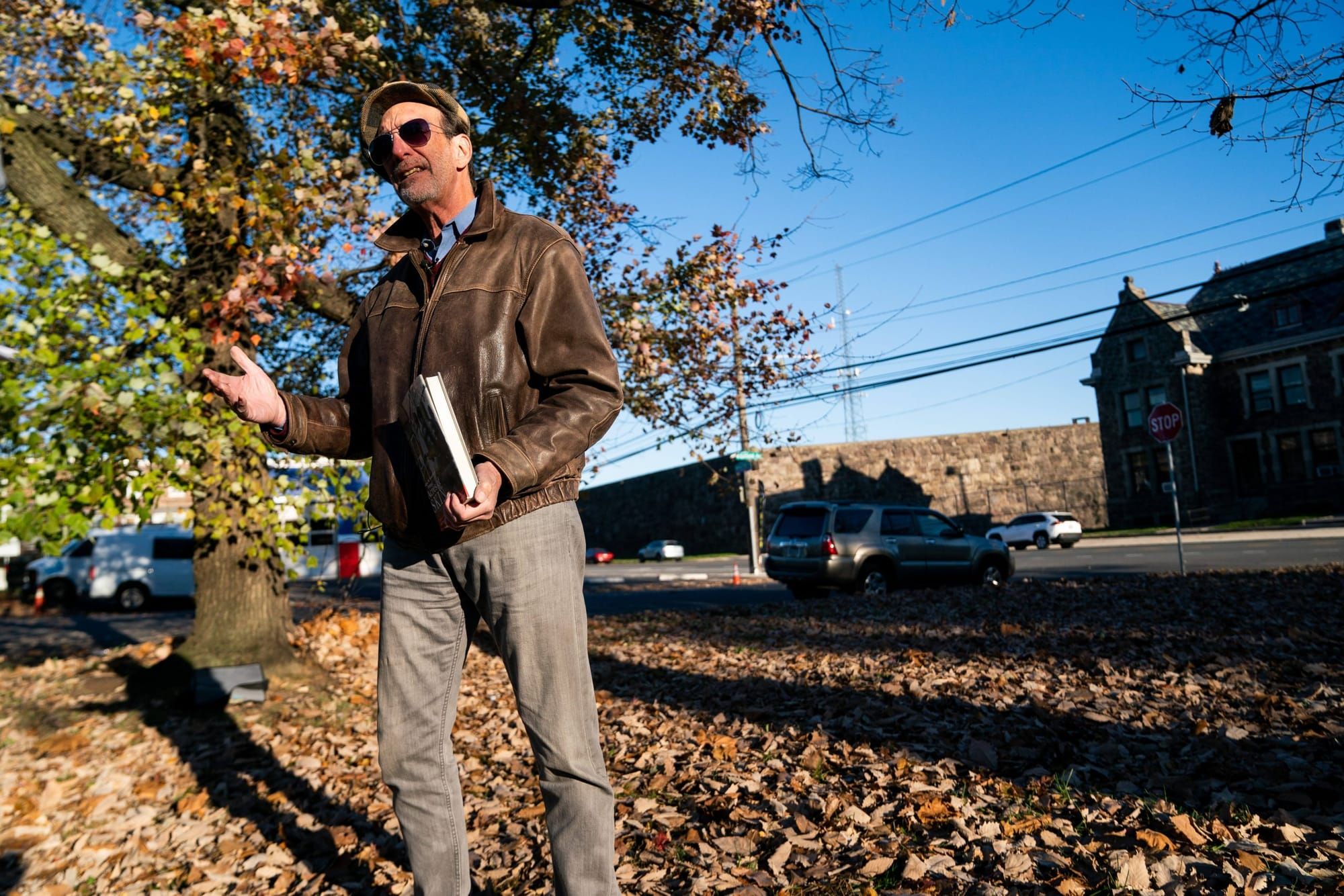
Scholars, writers, and activists came together in the University of Pennsylvania’s Fitts Auditorium on Oct. 23 to discuss and meditate on a troubling era of Philadelphia’s past that continues to shape present lives. Hosted by the Jones Foundation for Returning Citizens and moderated by Dr. Dorothy Roberts, the panel “The Holmesburg Prison Experiments and the Call of Restorative Justice” sought to educate the Penn community about the Holmesburg prison experiments. Fifty years after the Holmesburg experiments ended, Wednesday’s panel served as a moment to usher in what survivors and their families hope will be a new chapter.
As previously reported by Prism, the experiments at Holmesburg, a Philadelphia men’s prison that shuttered in 1997, began in 1951 when dermatologist Albert Kligman was brought in by prison officials to help treat an outbreak of athlete’s foot that had been plaguing men incarcerated at the facility. Upon his arrival, however, Kligman saw an opportunity to exploit the vulnerability of the men detained at the prison, offering them small payments in exchange for their participation as test subjects for his own research, in partnership with the University of Pennsylvania. The experiments, which produced products such as Retin-A, a popular topical treatment for acne and wrinkles, inflicted incarcerated participants with everything from skin burns to hemorrhoids and psychosis.
“All I saw before me were acres of skin,” Kligman told the Philadelphia Inquirer in 1961. “It was like a farmer seeing a fertile field for the first time.”
Wednesday’s event represented a marked shift in how Penn has engaged with this dark history. It featured over 10 sponsors, including Penn’s Black Law Students Association, the Program on Race, Science and Society, and the Amistad Law Project.
Present on Wednesday’s panel were Herbert Rice, an experiment survivor, and his grandson Ja’ir; Adrianne Jones-Alston, founder of the Jones Foundation for Returning Citizen and daughter of Holmesburg survivor; Michelle Munyikwa, resident physician at Penn; Melea Hayles, a first-year Penn law student; and Allen Hornblum.
Kligman’s experiments at Holmesburg tested the impacts of everything from perfumes to chemicals such as dioxin on the backs of incarcerated men. While Kligman achieved both material wealth and public achievements—including by the University of Pennsylvania—those who participated in the experiments experienced horrific—and enduring—side effects. The impact of the experiments on the lives and physical bodies has been well documented by writer Allen Hornblum, who in 1998 published “Acres of Skin,” the title pulled from Kligman’s chilling quote. The book also details Kligman’s failure to properly document who was enrolled in which tests, which continues to impede upon participants’ ability to understand what exact materials they were exposed to.
While the men of Holmesburg were the focus of Hornblum’s book and the center of a reparations movement that gained some momentum in the late 1990s, women were also acutely impacted by Kligman and the University of Pennsylvania’s tests. As previously reported by Prism, women detained at Philadelphia’s House of Correction were also asked to participate in the University of Pennsylvania’s sponsored tests on tampons. In an event hosted on Penn’s campus, Dorothy Alston, who was formerly incarcerated at the House of Correction, recalled the ailments she incurred as a result of her participation in the tampon tests. Upon her release, Alston underwent a hysterectomy, which then had a ripple effect on her health and personal life. Hornblum’s book speculates that such tests were conducted in partnership with Johnson & Johnson.
Largely spurred by the uprisings of 2020 in response to George Floyd’s murder by police, renewed attention has been given to the Holmesburg experiments in recent years. In 2021, the University of Pennsylvania issued a formal apology and a statement condemning Kligman’s work at Holmesburg. In 2022, the City of Philadelphia issued an apology to survivors as well.
Even despite Penn’s formal acknowledgement, the arms of the University that advocates argue should be most deeply concerned with the experiment and their survivors have remained silent. While the December event with Alston was the experiment-related event held on Penn’s campus, Hornblum noted that the University of Pennsylvania’s Department of Medical Ethics and Health Policy declined to sponsor it.
Wednesday’s panel highlighted the voices of experts on medical ethics as well as survivors and their families. The presence of survivors’ families, whom Jones-Alston has referred to as the “forgotten victims,” shows the long reach of the experiments, impacting even grandchildren.
For Dr. Arvilla Payne-Jackson, professor of Sociology and Criminology at Howard University, this generational impact illustrates the depth of the pain wrought by the experiments.
“It’s not just the men and the women, but it’s their kids and their grandkids,” said Dr. Payne-Jackson. “Trying to cope with what happened to your family member with such a callous, unfeeling, unethical attitude. They say, ‘we were treated like guinea pigs,’ and they were, and that, to me, is just unconscionable. It’s time that something is done.”
This inherited trauma is just one of a handful of similarities that Dr. Payne-Jackson has drawn between the Holmesburg experiments and the U.S. Public Health Service Untreated Syphilis Study at Tuskegee,which spanned from 1932 to 1972. Payne-Jackson has worked with the Voices for Our Fathers Legacy, an organization of descendants of the men involved in the study at Tuskegee, which aims to tell their untold stories. She notes that the two experiments also share similarities in that they were both rooted in commerce and profiteering on vulnerable populations, that experimenters displayed a lack of concern for the well-being of those involved, the trauma inherited by their families, and the lack of ethics and protocol.
In addition to educating audience members about the experiments, the panel also focused on thinking through what the future might look like for survivors and their families.
The Restorative Justice Initiative, a project created by Jones-Alston’s foundation, presented a path forward. It seeks to “bring healing, accountability, and reparative justice to the survivors and descendants of the unethical medical experiments conducted at Holmesburg Prison.”
The multipronged approach includes collaborating with international human rights organizations to embed the story of Holmesburg into a global conversation about medical ethics. The Initiative further seeks to provide reparative justice for survivors and their descendants through both community-based programming and financial compensation, which could support access to healthcare and education. Jones-Alston says this could even look like college scholarships for Holmesburg survivors’ descendants—funded by institutions, including the University of Pennsylvania.
A final and key part of the Restorative Justice Initiative is ensuring that the memory of the experiments is not forgotten. The Initiative aims to do so by implementing reforms in medical institutions to prevent future ethical violations and by integrating the history of the experiments into school curricula.
Dr. Payne-Jackson’s students played an instrumental role in developing the educational module. The curriculum aims to provide background about the history of the Holmesburg experiments, introduce the concept of restorative justice, and illustrate how it can be applied to survivors and their descendants.
“The restorative justice piece, I think, is critical. It’s been 50 years that people have been suffering,” said Dr. Payne-Jackson. “They’ve lost mental capacity due to the kinds of mental experiments that were done, [and have] physical scars, and disabilities that have stayed with them for a lifetime. We wanted to give just enough of the stories that aren’t in the public view to let them know there are still, there’s still more to the story than just ‘Acres of Skin,’ and we are still interviewing survivors.”
The module is designed to be used by both the general public and those in academia, and it can be applied to courses ranging from law and medicine to history and communications.
Wednesday’s event was the first of two last week hosted by the Jones Foundation. On Thursday, Oct. 24, Jones-Alston returned to St. Joseph’s University, speaking directly with students about the new educational module. An additional event in the Philadelphia area is planned for next February during Black History Month.
Author

Tamar Sarai is a writer, journalist, and historian in training. Her work focuses on race, culture, and the criminal legal system. She is currently pursing her PhD in History at Temple University where
Sign up for Prism newsletters.
Stay up to date with curated collection of our top stories.